Integrated, Light-Source Replaceable, and Modular Replaceable LED Luminaires: The Complete Guide
Integrated, Light-Source Replaceable, and Modular Replaceable LED Luminaires: The Complete Guide
What Is a Modular Luminaire? Pros, Cons, and Buying Guide for the Three Mainstream LED Lighting Types
1. Why You Need to Understand "Replaceable Luminaires"
Whether you are walking through a hardware store, browsing a wholesale showroom, or shopping online, you have almost certainly encountered three categories of LED luminaires: integrated (all-in-one) luminaires, light-source replaceable luminaires, and the increasingly popular modular replaceable luminaires. They all look like "LED lights," yet their prices can differ by a factor of two or more. What exactly is the difference, and which one is right for your home, store, office, or commercial project?
In plain terms, the key difference between these three categories has little to do with "how bright the light is" and everything to do with "what happens when something breaks." An integrated luminaire has to be discarded entirely; a light-source replaceable luminaire allows you to swap out the light source; a modular replaceable luminaire lets you change out the failed light source, driver, or housing independently. This seemingly small design difference will directly affect your maintenance costs, electricity bills, and even your organization's ESG performance for the next decade. This guide walks you through the definitions, advantages, ideal use cases, and procurement recommendations for all three categories in clear, accessible language.
2. What Is an Integrated (All-in-One) Luminaire?
An integrated luminaire (All-in-One LED Luminaire), also referred to as a "monolithic LED luminaire" or "integrated fixture," is an LED luminaire in which the LED light source (chip and PCB), driver, heat sink, and housing are all sealed inside the same non-dismantlable enclosure. From the outside, it looks like a complete, finished light fixture — there is no dismountable component, and the user can only install or remove the entire luminaire as a whole.
Common integrated luminaires include ceiling lights, downlights, panel lights, track lights, and outdoor floodlights. Since LED technology matured in 2015, integrated luminaires have rapidly replaced traditional fluorescent fixtures in Taiwan and become the mainstream choice for new construction, interior fit-out, and renovation projects.
%20Luminaire.jpg)
3. Advantages of Integrated Luminaires
Integrated luminaires have captured market share so quickly because they offer several practical benefits:
- Lowest unit purchase price: Simple structure and large-scale mass production mean that, for the same wattage, they are usually the cheapest of the three categories — particularly well-suited to small projects with tight budgets.
- Plug-and-play installation: Open the box, connect the power, and you are done. No ballast wiring, no extra cabling — installation is quick.
- Wide design variety: Because the housing is sealed and need not accommodate dismantling, integrated luminaires can be made slimmer and more visually integrated with ceilings and interior styles.
- Initially maintenance-free: With a rated lifetime of 25,000 to 50,000 hours, replacement is rarely required within 5–7 years of normal use (actual lifespan still varies with operating conditions).
However, the biggest hidden cost of an integrated luminaire is that "once it breaks, the entire unit has to be replaced." The most common failure mode in an LED luminaire is not the LED chip itself but the aging of electrolytic capacitors inside the driver. Because the driver, light source, and housing are welded or sealed together, a single failed component forces the entire luminaire to be discarded — generating significant electronic waste and resulting in poor long-term repair economics.
4. What Is a Light-Source Replaceable Luminaire?
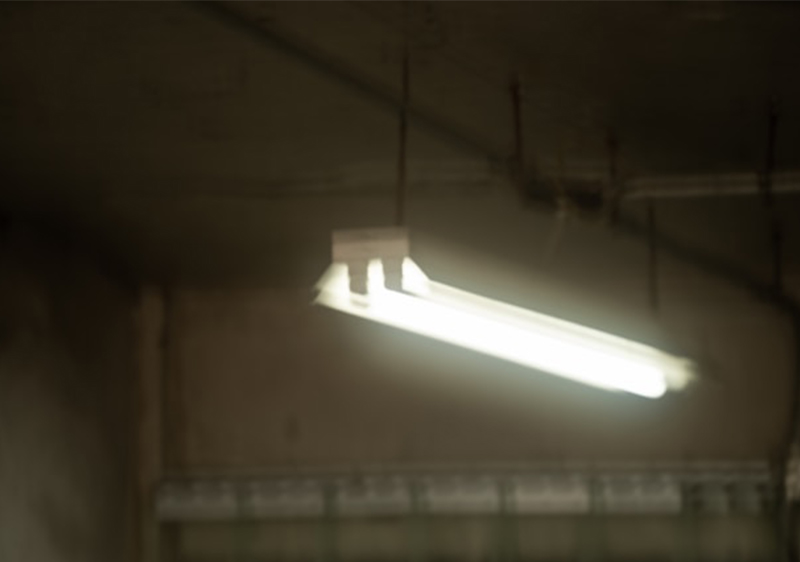
A light-source replaceable luminaire (Replaceable Light Source Luminaire), also called a "separated LED luminaire" or "LED luminaire with replaceable tube/bulb," is a design in which the luminaire body (housing, sockets, and sometimes the ballast or driver) is preserved, while only the "light source" itself can be replaced. Common formats include T8/T5 LED tube sockets, downlights that accept LED bulbs, and track lights that accept replaceable LED COB modules.
The light-source replaceable concept actually inherits the long-standing tradition of independently replaceable tubes and bulbs from the fluorescent and halogen eras. When LED technology became widespread, the industry introduced LED tubes and LED bulbs designed to fit directly into existing fixtures, allowing users to upgrade from fluorescent to LED simply by changing the light source — without replacing the luminaire itself.
Reference product pages
↪︎ [T8 LED Tube] [T5 LED Tube] [Anti-UV Yellow Light T8 LED Tube for Semiconductor]
5. Advantages of Light-Source Replaceable Luminaires
The core value of light-source replaceable luminaires is to "reduce waste and extend luminaire lifespan." The key benefits include:
- Replace only the light source, not the whole luminaire: When the lamp dims, fails, or you want to upgrade color temperature or brightness, you only need to change the light source. The original housing and socket remain in use, drastically reducing electronic waste.
- The best first step for upgrading fluorescent to LED: For existing buildings, there is no need to disturb the ceiling, rewire, or rerun cabling. Replacing fluorescent tubes with LED tubes (or bulbs) completes the LED transition — the lowest-cost entry-level retrofit approach available.
- Diverse procurement options: The market offers a rich selection of LED tube and LED bulb brands and specifications. You can choose high-CRI, high-lumen, dimmable, or other variants based on need — high flexibility.
- Extend the lifespan of the housing: Luminaire housings are typically designed to last 15+ years, far exceeding the lifespan of any single light source. The replaceable-source design ensures you don't have to discard an otherwise functional luminaire just because a lamp failed — fully aligned with the principles of the circular economy.
6. What Is a Modular Replaceable Luminaire?
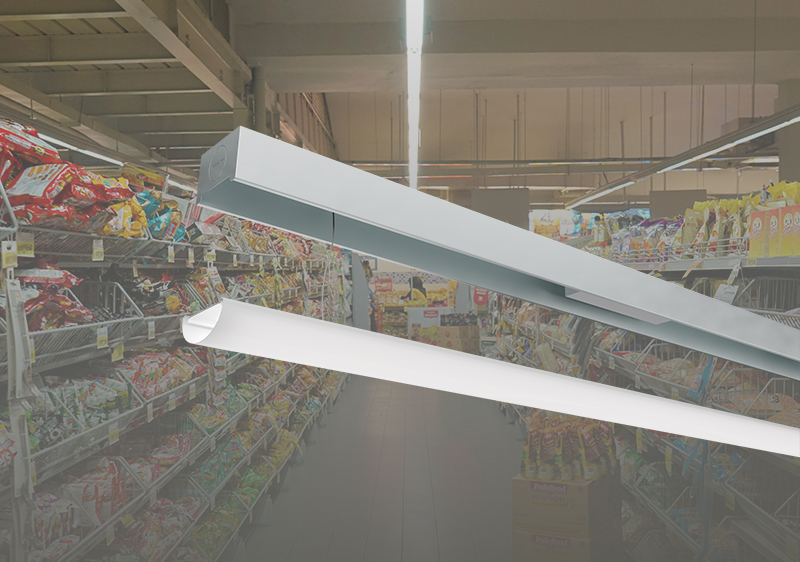
A modular replaceable luminaire (Modular Replaceable Luminaire), also known as a "modular luminaire" or "replaceable modular LED luminaire," is the next-generation LED lighting design that solves the two key pain points of the previous categories: the "fail-once, discard-all" problem of integrated luminaires, and the "driver cannot be replaced" limitation of light-source replaceable luminaires. The core idea is to break apart the traditionally sealed "black box" and divide the entire luminaire into multiple independently replaceable standard modules.
A typical modular replaceable luminaire consists of three primary modules:
- Light Engine (light source module): An LED board integrated with optical lenses, installed via standardized clips or quick-connect terminals. When the light source dims or you want to upgrade color temperature, you replace only the light engine.
- Driver Module: A separately packaged power driver — the most failure-prone component of any luminaire. Modular design allows it to be removed and swapped from the back or side of the fixture, and it can be easily upgraded to dimmable, flicker-free, or smart-control versions.
- Housing and Heat-Dissipation Structure: Built from aluminum alloy with structural lifespans of 15+ years. When light engines or drivers are updated, the housing remains in service, substantially reducing material consumption.
7. Advantages of Modular Replaceable Luminaires
Modular replaceable luminaires are currently the most sustainable and most flexible LED luminaire design. The primary advantages include:
- Precise repair, no waste: Replace only the failed module, not the entire luminaire. A failed driver doesn't require discarding the whole fixture.
- Repair time reduced from 30 minutes to 3 minutes: Modules can be swapped with no tools or simple tools — facility personnel can do it themselves, no need to call in a licensed electrician. Especially beneficial for 24/7 operations.
- Staged upgradability: When you later introduce smart-control protocols such as DALI, Zigbee, or Matter, you only need to replace the driver module — no need to swap out the entire luminaire. Smart building and BACS (Building Automation and Control Systems) integration becomes effortless.
- Lowest total cost of ownership (TCO): Although the unit purchase price is 15–25% higher initially, 10-year TCO is approximately 20–30% lower than integrated luminaires, with savings scaling dramatically for projects with hundreds or thousands of fixtures.
- Electronic waste reduction of 60–70%: By precisely replacing only the failed module, the "whole-luminaire scrap" cycle is eliminated — a textbook example of "resource efficiency" and "waste management" for ESG sustainability reporting.
- Aligned with international Right-to-Repair regulation: The EU's ESPR (Ecodesign for Sustainable Products Regulation) and Right-to-Repair laws emerging worldwide all encourage or mandate product designs with repairable, replaceable components. Modular luminaires sit at the forefront of this trend.
8. Legacy Fluorescent Fixtures vs. Best Energy Saving Tech Replaceable LED Modules: Complete Wattage and Lumen Comparison
Best Energy Saving Tech's CombiMod series of replaceable LED module luminaires is most commonly used to retrofit the four major categories of legacy fluorescent fixtures found throughout factories, plants, offices, classrooms, retail, and public spaces in Taiwan — batten lights, industrial batten lights, Mid-East type pendant lights, and troffer (drop-ceiling grid) lights. These four categories account for the overwhelming majority of the installed lighting base in Taiwan's commercial and public spaces, and are the most impactful targets for energy-saving retrofits. Before reviewing the energy-saving figures, let's briefly introduce each fixture type and its typical applications:
8.1 Batten Light
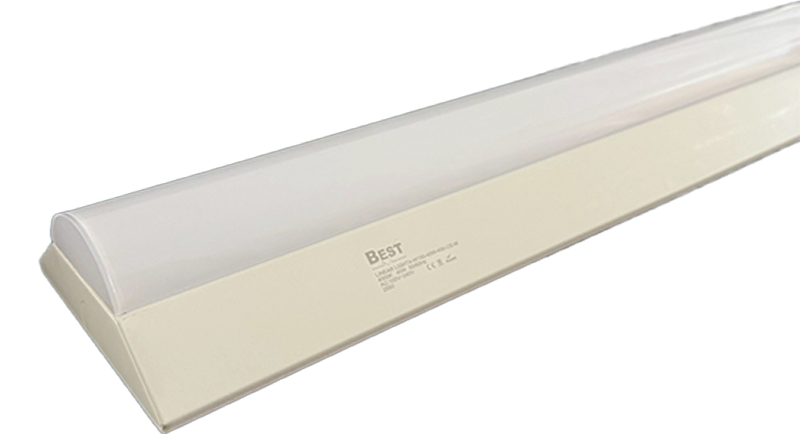
The batten light, also called the "inverted Fuji" fixture in the local industry, takes its name from the inverted-V (mountain-shaped) housing profile. It is the most common fluorescent fixture in Taiwan's factories, warehouses, parking lots, corridors, and arcaded sidewalks. Typically built around 1- or 2-tube 4 ft T8 fluorescent lamps, the design is simple, sturdy, and time-tested.
Reference product pages
↪︎ CombiMod Series — 150mm Linear Batten Ceiling Light
↪︎ CombiMod Series — 230mm Linear Batten Ceiling Light
8.2 Industrial Batten Light
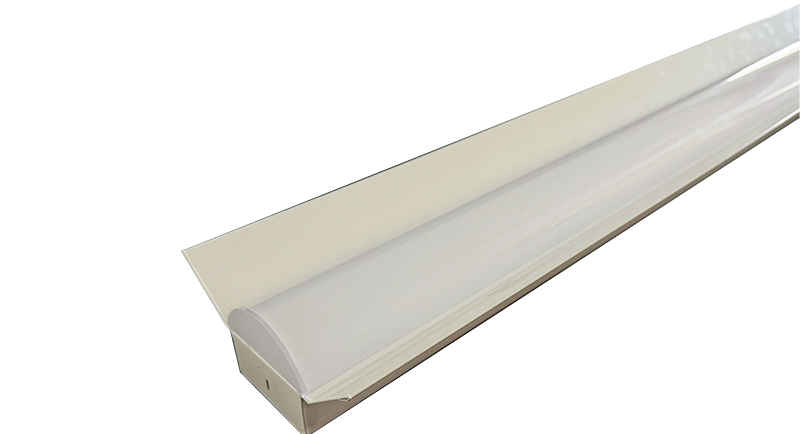
The industrial batten light, also known as a work light or industrial-grade luminaire, pairs the lamp with a reflector to enhance downward-directed lumen output. It is engineered for factories, mechanical rooms, basements, parking garages, warehouses, logistics centers, storefronts, offices, and schools. The design emphasis is on concentrated lumen output, making it one of the workhorses of commercial and industrial lighting.
Reference product page
↪︎ CombiMod Series — 150mm Industrial Batten Light
8.3 Mid-East Type Pendant Light (Batten Light)
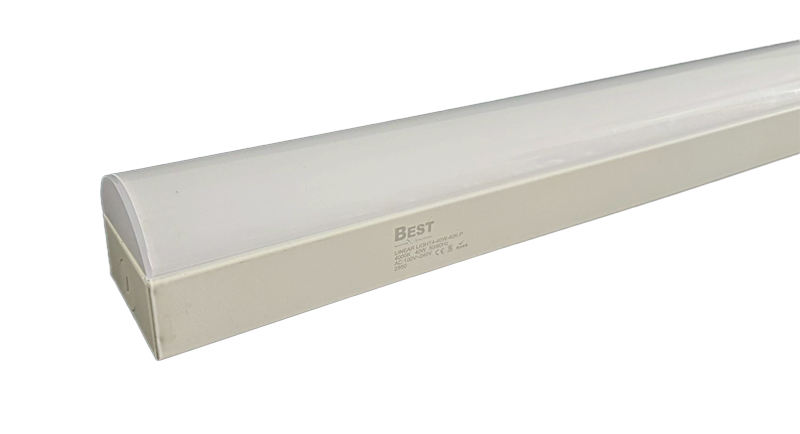
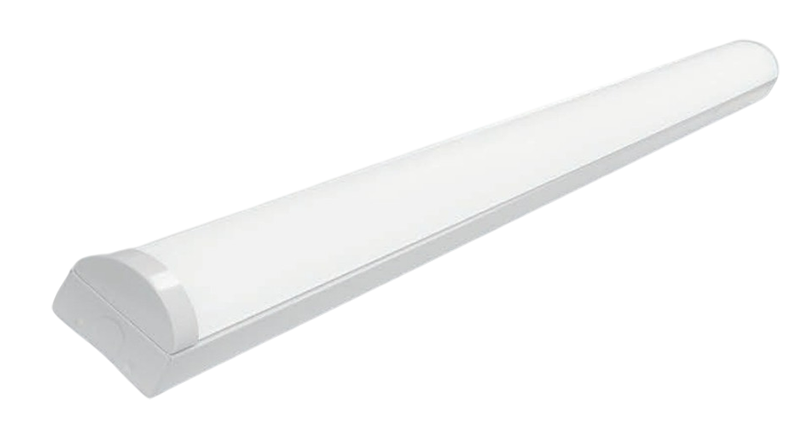
The Mid-East type pendant light earned its name from heavy export volumes to the Middle East market, after which it became widely adopted in the local market. It has no reflector — the lamp simply faces downward, producing a more diffused light distribution. Typically built around 1 or 2 tubes of 2 ft or 4 ft T8 fluorescent lamps, it is widely found in auto repair shops, gas stations, machine shops, self-service car washes, arcaded corridors, night-market stalls, and back-of-house areas in large retail centers. The structure is simple, durable, and offers flexibility in mounting height.
Reference product pages
↪︎ [2ft / 4ft CombiMod Standard and IP65 Mid-East Type Pendant Light]
8.4 Troffer Light (Drop-Ceiling Grid)
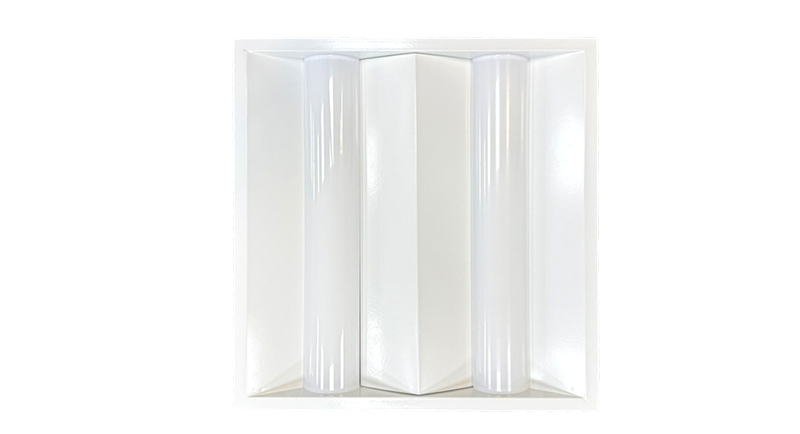
The troffer light is a recessed grid-reflector fluorescent luminaire mounted in suspended (drop-ceiling / T-bar) grids. Standard sizes are 60×60 cm or 60×120 cm, housing 2, 3, or 4 T8 fluorescent tubes. It is widely deployed in offices, classrooms, meeting rooms, bank lobbies, hospital corridors, and government counter spaces — by far the most numerous luminaire type in Taiwan's commercial and public buildings.
Reference product page
↪︎ CombiMod Series: 60x60 Recessed Square Troffer Light Set
8.5 Replaceable Modular Luminaires as Direct Replacements for Legacy Fixtures
The table below uses the most commonly installed on-site specifications to compare legacy batten / industrial batten / troffer fluorescent fixtures against Best Energy Saving Tech's CombiMod series of replaceable modular luminaires in terms of "power consumption (wattage)" and "luminous flux (lumens)" — these are fixture series that can be swapped in as direct, drop-in replacements:
| Fixture Type | Common Spec | Best Energy Saving Tech CombiMod Series Wattage (Lumens) |
Replaced Fluorescent Wattage (Lumens) |
|---|---|---|---|
 |
|||
| Batten Light | 1-tube 2 ft | 10W (1600lm) | 20W*1 (1,260lm) |
| Batten Light | 2-tube 2 ft | 16W (2560lm) | 20W*2 (2,800lm) |
| Batten Light | 1-tube 4 ft | 20W (3200lm) | 40W*1 (2,800lm) |
| Batten Light | 2-tube 4 ft | 32.5W (5,200lm) 50W (8,000lm) |
40W*2 (5,040lm) |
 |
|||
| Industrial Batten | 1-tube 2 ft | 10W (1,600lm) | 20W*1 (1,260lm) |
| Industrial Batten | 2-tube 2 ft | 16W (2,560lm) | 20W*2 (2,800lm) |
| Industrial Batten | 1-tube 4 ft | 20W (3,200lm) | 40W*1 (2,800lm) |
| Industrial Batten | 2-tube 4 ft | 32.5W (5,200lm) 50W (8,000lm) |
40W*2 (5,600lm) |
 |
|||
| Mid-East Pendant | 1-tube 2 ft | 10W (1,600lm) | 20W*1 (1,260lm) |
| Mid-East Pendant | 2-tube 2 ft | 16W (2,560lm) | 20W*2 (2,520lm) |
| Mid-East Pendant | 1-tube 4 ft | 25W (4,000lm) | 40W*1 (2,520lm) |
| Mid-East Pendant | 2-tube 4 ft | 32.5W (5,200lm) 50W (8,000lm) |
40W*2 (5,040lm) |
 |
|||
| IP65 Waterproof Mid-East Pendant | 2-tube 2 ft | 16W (2,560lm) | 20W*2 (2,520lm) |
| IP65 Waterproof Mid-East Pendant | 2-tube 4 ft | 32.5W (5,200lm) | 40W*2 (5,040lm) |
 |
|||
| Troffer | 2 ft×2 ft / 2-lamp PL-L compact tube |
16W*2 (5,200lm) | 20W*2 (2,520lm) |
| Troffer | 2 ft×2 ft / 3-lamp PL-L compact tube |
21.5W*2 (6,900lm) | 20W*3 (3,780lm) 40W*2 (5,040lm) |
| Troffer | 2 ft×2 ft / 4-lamp PL-L compact tube |
25W*2 (8,000lm) | 20W*4 (5,040lm) 55W*2 (7,700lm) |
As the table clearly shows, across all three legacy fixture categories the replaceable modular luminaires consistently achieve "half the wattage with equal or higher luminous flux," delivering a substantial energy-saving effect.
9. ESG, Sustainability, and Energy Regulation Trends
In recent years, corporate ESG (Environmental, Social, Governance) reports, TCFD climate-related financial disclosures, and SBTi science-based emission-reduction targets have rapidly reshaped commercial procurement logic. As one of the single largest energy-consuming categories in commercial spaces, lighting has become a key lever for corporate decarbonization. Replaceable luminaires (both light-source replaceable and modular replaceable) offer pronounced advantages on ESG dimensions:
- Major reduction in electronic waste: Traditional integrated luminaires are scrapped wholesale upon failure. Modular designs can cut electronic waste by 60–70%, while light-source replaceable designs extend housing lifespan — both significantly reduce environmental impact.
- Aligned with EU Ecodesign and Right to Repair: The EU's ESPR (Ecodesign for Sustainable Products Regulation) and the Right-to-Repair legislation rolling out in multiple jurisdictions both require products to incorporate replaceable-component design. Replaceable luminaires therefore enjoy a compliance advantage when entering European markets or international supply chains.
- Easier energy-subsidy qualification: Programs such as Taiwan's Bureau of Energy incentives, Taipower's energy-efficiency improvement subsidies, and ISO 50001 energy management certification favor lighting systems that can be upgraded and intelligently controlled. Modular replaceable luminaires — which can be upgraded to higher-efficiency drivers or smart-control versions at any time — meet these criteria most readily.
- ESG report highlights: Deploying repairable, upgradeable lighting systems can be cited directly under "resource efficiency," "waste management," and "circular economy" sections of a corporate sustainability report — improving disclosure quality and external ratings scores.
10. Application Recommendations: Which Projects Should Adopt Modular Luminaires?
Not every project needs to migrate to modular replaceable luminaires immediately. Below are the highest-impact application categories where deployment delivers the strongest return:
10.1 Large Industrial Facilities, Logistics, and Retail
Sites typically deploy hundreds to thousands of fixtures, where maintenance labor and downtime are the dominant pain points. Modular luminaires allow on-site facility teams to replace failed components quickly without dispatching outsourced electricians, reducing annual maintenance budgets by 30–50%.
10.2 24/7 Operating Environments
Hospitals, convenience stores, airports, transit terminals, gas stations, and 24-hour restaurants are highly sensitive to "downtime for lamp replacement." Modular replaceable luminaires' quick-swap capability can compress per-fixture downtime from roughly 30 minutes to 3 minutes — dramatically reducing operational disruption risk.
10.3 Projects Planning Smart-Building / BACS (Building Automation And Control Systems) Integration
If the owner intends to integrate smart-control protocols such as KNX, DALI, Zigbee, or Matter within the next 3–5 years, modular luminaires allow installation of the housing and light engine now and a later, isolated driver upgrade when budget or technology matures — eliminating the risk of "redoing the work later."
10.4 Enterprises Pursuing ESG Disclosure or Green-Building Certification
For projects pursuing LEED, WELL, EEWH, or SITES green-building or healthy-building certifications, modular luminaires earn credit under "Materials and Resources," "Indoor Environmental Quality," and "Innovation" categories.
10.5 Existing Buildings Without Major Renovation Budgets
If a building's existing lighting system is still functional and the owner wants a low-impact phase-one LED conversion, the light-source replaceable approach is the most pragmatic first step — replace fluorescent tubes with LED tubes. The next major renovation cycle can then upgrade the fleet to modular replaceable luminaires, balancing budget control and long-term sustainability.
10.6 Campuses and Educational Institutions (Classrooms, Labs, Activity Centers)
Primary, secondary, and tertiary education classrooms — together with cram schools — represent the largest application base for troffer (drop-ceiling grid) luminaires in Taiwan. The Ministry of Education and municipal governments are rolling out "campus energy retrofit," "smart campus," and "eye-friendly classroom" programs that require replacing legacy fluorescent fixtures with high-CRI (≥80), flicker-free, dimmable LED module luminaires to protect students' vision and teaching quality. Modular luminaires offer particular value here: maintenance can be performed by janitorial or facility staff without class disruption; light engines can be upgraded independently if lumens fade or color temperature must change; and when smart-classroom or energy-monitoring systems are later introduced, only the driver module needs updating — no fleet-wide replacement is required.
10.7 Underground Parking, Parking Towers, and Motorcycle Parking
Underground garages, indoor motorcycle parking, and large-scale automated parking towers traditionally rely on T8 fluorescent or aging integrated LED fixtures, with common pain points including uneven illumination, severe flicker, rapid lifetime decay due to 24/7 operation, and the requirement for high-altitude maintenance work and traffic-lane closures during repairs. Modular replaceable luminaires paired with radar or PIR motion-sensing driver modules can automatically dim during unoccupied periods (10–30%) and ramp instantly to full brightness (100%) when motion is detected. Overall energy savings of 60–80% are achievable, and the lifespan of both LEDs and drivers is significantly extended — making this the optimal lighting solution for property management firms, parking operators, and condominium / commercial-building management committees seeking to balance public-safety illumination, ROI, and energy-subsidy qualification.
11. The Next Decade of Lighting Engineering Begins with "Replaceability"
Lighting technology has evolved from tungsten incandescent bulbs through fluorescent tubes to LED integrated luminaires. Each generation solved the previous generation's problems — but introduced new ones. While integrated LED fixtures resolved the efficacy and lifespan limitations of fluorescents, they shifted a hidden cost — the "fail-once, scrap-all" cycle — onto building owners and the environment. Light-source replaceable and modular replaceable luminaires represent the lighting industry's answer to this challenge.
If we summarize the selection logic in a single sentence :budget-constrained, short-term use — choose an integrated luminaire; renovating an existing building and want to extend housing lifespan — choose a light-source replaceable luminaire; new large-scale project pursuing sustainability and long-term ROI — choose a modular replaceable luminaire.
The value of a lighting system has never been just "producing light." When owners begin selecting luminaires through the lens of "replaceable, upgradeable, circular," lighting ceases to be a 10-year disposable consumable and becomes a long-term asset that grows alongside the building. In the next decade, the keyword for lighting engineering will no longer be "whole-fixture replacement" — it will be "precise modular replacement." And that transformation begins with the luminaires you specify on your next project.
About Best Energy Saving Tech
Best Energy Saving Tech is a professional manufacturer of commercial lighting products with a focus on optoelectronic R&D. We provide ODM and OEM services, along with commercial, industrial, and office lighting planning and design. Please feel free to contact us to learn more.
We offer a broad range of LED retrofit solutions, including industrial lighting, factory lighting, school lighting, office lighting, library lighting, machine/equipment lighting, commercial/retail lighting, museum lighting, and other indoor and outdoor lighting applications.
Luminaire manufacturers, lighting designers, interior designers, project engineers, and other professionals seeking high-quality LED retrofit solutions are welcome to contact us for business cooperation opportunities.
Tel: +886-6-230-9930
Fax: +886-6-230-9667
E-MAIL: [email protected]
Address: No. 36, Minsheng 12th St., Guiren Dist., Tainan City 711009, Taiwan